Report from GlobusWorld 2025: Going Beyond Data
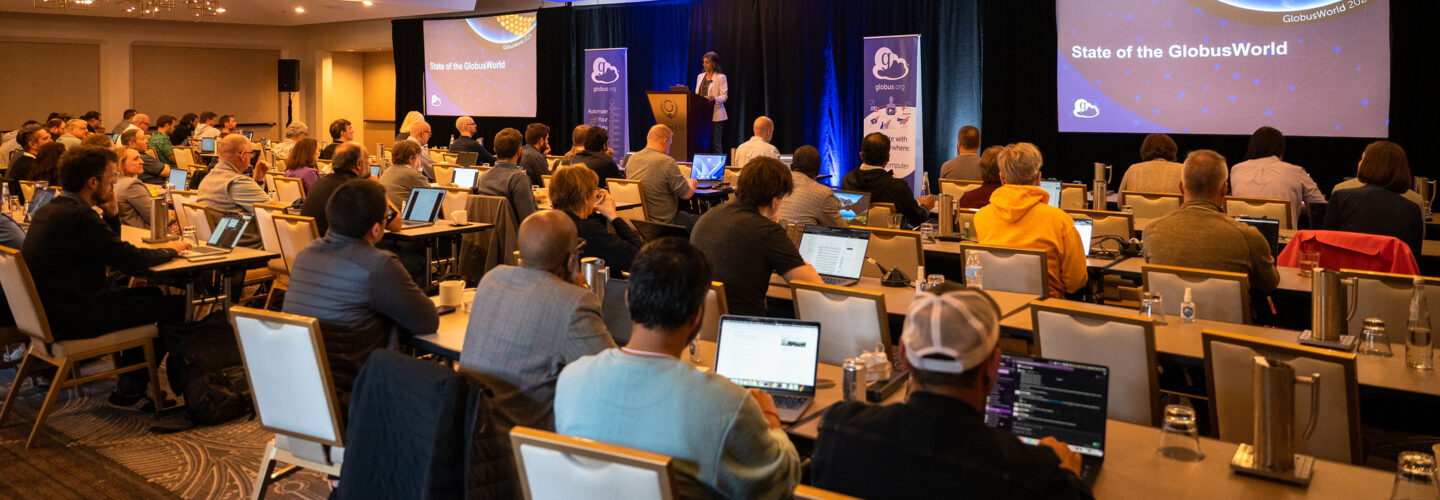
GlobusWorld 2025, now in its 23rd year, brought together over 130 researchers, system administrators, developers, and IT leaders from 42 top research computing centers, national laboratories, federal agencies, and universities worldwide. The conference serves as a forum for insights into new methods for managing research storage and computation at scale, as well as for building cutting-edge data portals and science gateways that advance scientific research.
Globus Tutorials, Deep Dives, and a Keynote
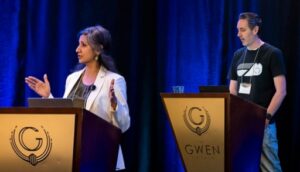
After a morning of technical tutorials, the conference began with a welcome address by Globus co-founder Ian Foster, followed by an opening keynote by Rachana Ananthakrishnan, Executive Director and Head of Products at Globus. Ananthakrishnan described how Globus, with reliable and secure hosted, persistent, scalable, and resilient services combined with local agents and plug-ins, delivers the services required to overcome many data management hurdles researchers face in today’s globally distributed IT environments. She provided numerous real-world examples that demonstrate how Globus is utilized within US national laboratories and leading research organizations to accelerate workflows and pipelines for data analysis. She described new features and future product plans, including support for streaming data and additional compliance regimes. Anathakrishan also highlighted the recently announced partnership with Internet2, which makes Globus subscriptions available via the NET+ Program, as well as the free subscriptions available to grant awardees of the National Science Foundation’s CC* program.
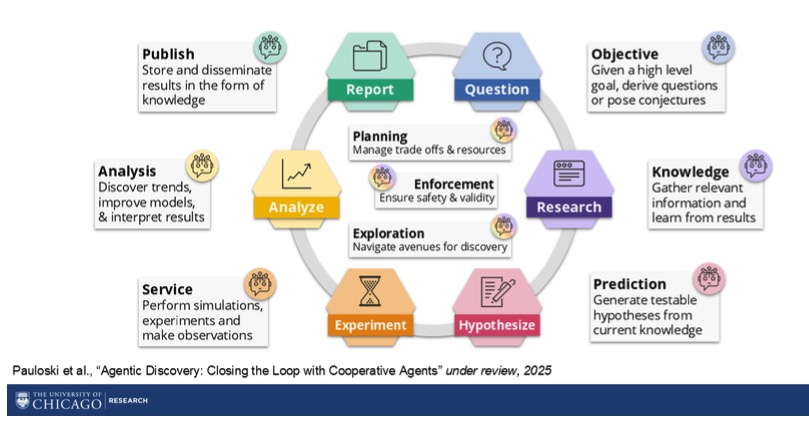
The keynote continued with Kyle Chard, Research Associate Professor and lead of Globus Labs. Dr. Chard focused on a topical theme at the conference: how AI and ML are transforming scientific discovery and how scientific computing will become increasingly “agentic,” with most steps of the scientific method outsourced to a collection of AI-enabled agents.
Reimagining Research IT
GlobusWorld 2025 hosted a diverse lineup of invited speakers spanning the gamut of research computing and data professionals, as well as researchers themselves. Brian Roland from Northwestern University presented their enterprise implementation of Globus Connect Server on Amazon Web Services and how they are managing the migration of a research data archive from on-premise storage to AWS S3 at their institution. Rick Wagner, CTO of the San Diego Supercomputing Center (SDSC), talked about the deployment of Globus Compute multi-user endpoints on SDSC’s Expanse system and how the service can standardize programmatic access across SDSC’s HPC resources, thereby enhancing security, access modalities, integration, and automation.
Dimitrios Bellos, a research software engineer at the Rosalind Franklin Institute (RFI) in the UK, was awarded this year’s Globus Community Award for his extensive work with the Globus platform and for championing its broad deployment as a critical technology at RFI. Bellos commented, “I am deeply honored and grateful to receive this year’s Globus Community Award! This award means a lot not only to me but to the whole Advanced Research Computing (ARC) team here at the Rosalind Franklin Institute, and we truly appreciate the recognition. The hard work that it represents is part of a team effort between

Franklin’s ARC team and the Globus Support team.”
Day One ended with an outdoor reception on the Gwen Hotel terrace, where attendees could recharge and make new connections with peers and Globus team members.
Transforming Scientific Discovery with AI/ML
Day two included a morning of sessions on transforming scientific discovery with AI and ML. Dr. Chard kicked off the morning with a presentation on how Globus supports AI processes across various stages of model training and inference, highlighting its role in facilitating advanced AI research and deployment. This presentation was followed by invited talks on leading-edge developments in AI/ML for Science: Zhao Zang, Assistant Professor at Rutgers, discussed Diamond, a service designed to facilitate large model training; Ravi Madduri, a senior scientist at Argonne National Laboratory, presented the APPFLx platform for secure, privacy-preserving, federated learning across distributed large-scale, high-performance computational resources; and Ryan Jacobs, a scientist at the University of Wisconsin-Madison, highlighted the need for the availability of persistent, easily accessible and usable machine learning models of materials.
Both days included well-attended sessions of Globus Office Hours—everyone’s favorite time, where Globus developers dive in and address attendees’ questions about the service.
The full program and list of speakers are available here.
Attendee response was very positive. Ana Mrija S., Research Scientist, Genomic Analysis, University of Chicago & University of Illinois at Chicago, mentioned, “I just wrapped up the GlobusWorld Conference 2025 here in Chicago – and I’m still reflecting on how transformative the Globus ecosystem has become for research computing and HPC workflows. Honestly, I barely remember how we used to move data before Globus.”
Dimitrios Bellos, Research Software Engineer, the Rosalind Franklin Institute and Globus Community Award winner, concluded, “I would like to offer my heartfelt congratulations to the whole Globus team for organizing and hosting this year’s GlobusWorld 2025 conference! The event was truly inspiring and well-executed, offering multiple valuable insights regarding the full extent of Globus platform capabilities and also providing the opportunity for many engaging discussions amongst us, the attendants, and the Globus team.”
This article was originally published by Susan Tussy at HPCWire.com